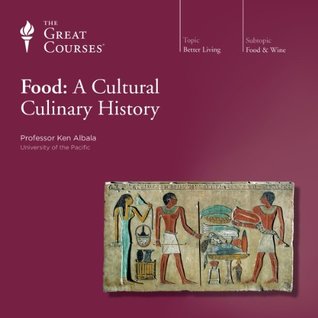
The Great Courses - Food: A Cultural Culinary History - Ken Albala, Ph.D. Audiobook
Shared by:ihophats
Written by ,
Read by Ken Albala, Ph.D.
Format: MP3
Bitrate: 128 Kbps
Unabridged
Length: 18 hrs and 22 mins
Release date: 07-08-13
Eating is an indispensable human activity. As a result, whether we realize it or not, the drive to obtain food has been a major catalyst across all of history, from prehistoric times to the present. Epicure Jean-Anthelme Brillat-Savarin said it best: “Gastronomy governs the whole life of man.”
In fact, civilization itself began in the quest for food. Humanity’s transition to agriculture was not only the greatest social revolution in history, but it directly produced the structures and institutions we call “civilization.”
In every era, the unfolding of history has been intimately tied to the need for food, the production of food, and the culture of food. In all major religions, food choice has been an integral part of religious identity. The quest for spices and exotic foodstuffs led to the European discovery of the New World, as well as to the connecting of the entire globe through trade. In 1840s Ireland a single food—the potato—changed the course of history. Modern warfare, from Napoleon’s conquests to World War II, was made possible by advances in food technology.
In our own times, more people worldwide now recognize the McDonald’s “golden arches” than the Christian cross. Beyond feeding our bodies, food choices and ideologies express social distinctions, as well as our values, concerns, and aspirations. For all of these reasons, food offers a deeply insightful lens on human history, shedding new light on the evolution of social and political systems, on cultural interactions, economic empires, human migrations, and more. Through food culture, we see how primary biological needs have shaped all human lives through the ages. The history of food is the history of human life at its most elemental, its most intimate, its most essential. It’s also a story of ingenuity, creativity, and remarkable human behavior to rival any other aspect of culture.
In Food: A Cultural Culinary History, award-winning Professor Ken Albala of the University of the Pacific puts this extraordinary subject on the table, taking you on an enthralling journey into the human relationship to food. With this innovative course, you’ll travel the world discovering fascinating food lore and culture of all regions and eras—as an eye-opening lesson in history as well as a unique window on what we eat today.
Incorporating extensive study of historical recipes, food preparation techniques from around the world, and activities you can try at home, these 36 colorful lectures take you through the entire spectrum of food history, from the cuisine of ancient Egypt to the great flowering of European cookery in the Middle Ages, and from the celebrity chefs of 18th-century France to our own Zagat- and Michelin-rated restaurant culture. Along the way, you learn in depth about food production and technology in each era; the social, economic, and political factors surrounding food culture; and thinking on diet and eating through the centuries. The result is a compelling inquiry that will change the way you look at both history and food itself.
Food as a Driver of Human History
As context for exploring humanity’s remarkable food cultures, you observe the integral role of food in the unfolding of civilization. From prehistory to our own era, your study includes these seminal subjects:
The revolutions of agriculture: Learn how agriculture arose in the prehistoric world and how it spurred the development of urban organization, political systems, social classes, militaries, and trade.
Food and faith: Grasp how food practices became core expressions of religious faith in Christianity, Judaism, and Islam, as well as in the Eastern traditions of Buddhism, Hinduism, and Taoism.
1492 and food globalization: Track the great trading empires of the Venetians, Portuguese, and Spanish, and the “Columbian exchange,” where plants and animals from five continents were transplanted across the world.
Coffee, tea, sugar, and slaves: Discover how the trade in a group of superfluous luxury items in the era of European colonialism altered the focus of the global economy.
Eating in the Industrial Revolution: Learn how capital-intensive, mass food production in the Industrial Revolution forever changed human diet and nutrition.
Big business and food imperialism: Observe the vast industrialization of food production in the late 19th and 20th centuries; its economic and human consequences; and the ideologies, movements, and practices that arose to oppose it.
A Global Richness of Culinary Cultures
At the heart of the course, you delve deeply into classic food traditions around the world. Among civilizations of Europe, Asia, Africa, and the Americas, your inquiry highlights these traditions:
Status and ritual in ancient Rome: Learn how Roman food reflected social rank, wealth, and sophistication, and investigate the dining habits of the upwardly mobile as well as the gastronomic eccentricities of the emperor Heliogabalus.
The exquisite flavors of medieval Islamic cuisine: In a culture with no injunction against pleasure, learn how the medieval Muslims’ sensual dishes—richly spiced, colored, or perfumed—reflected visions of a paradise on earth.
Aztec food culture: In this unique New World tradition, discover the Aztec way of life—the indigenous foodstuffs, eating rituals, and “signature” foods, from chilies to chocolate.
Sumptuous dining in the Renaissance: Study the sophistication and complexity of Renaissance-era food culture in the writings of Platina, Ficino, and Messisbugo, and witness the extravagance of banquets at the court of Ferrara.
The genesis of French haute cuisine: Grasp the aesthetics of French 17th-century cookery, based in refinement and pureness of flavors and study four Gallic cookbooks that revolutionized culinary history.
“Scientific” cooking in the 21st century: In our own diverse era, encounter the phenomenon of “molecular gastronomy”—technology-enhanced food creations designed to titillate and amaze the palate.
A Colorful and Diverse Learning Experience
Expanding on the lectures and in-studio demonstrations of food preparation techniques, the course guidebook presents a series of 39 hands-on activities—where you can learn how to make everything from Egyptian beer to Elizabethan “Chickin Pye”—that give you direct experience of how people cooked, ate, and thought about food in past eras. You also practice medieval eating rituals, track the rich evocation of food in art, and immerse yourself in the poetic ambiance of classic Japanese dining.
Across the span of the centuries you sample important food writing from many cultures, from the world’s first surviving recipes written in cuneiform to the lavish dishes of Apicius of Rome, and from the classic medieval cookbooks of Taillevent and Chiquart to the 19th-century Guide Culinaire by Escoffier.
And, throughout the series, the lectures pulsate with surprising and intriguing details of the human adventure with food:
Dinner knives with rounded tips were developed to reduce the threat of violence at the table.
The English word “dinner,” from the Latin disjejunare, literally means “break-fast.”
The banana, which we know as a single fruit, actually exists in hundreds of diverse varieties.
The world’s first restaurant-based food culture was Edo-era Japan.
The separation of sweet and savory flavors that we know today is relatively recent historically. Before the 16th century, meat and fish were often cooked with sugar, fruit, and syrups.
The Middle Ages produced some of history’s most outlandish and theatrical presentations of food, such as gilded boars’ heads; “invented” creatures, mixing parts of different animals; and cooked peacocks spewing flames.
Food: A Cultural Culinary History offers you an insightful and startlingly different view of our civilization that you won’t find anywhere else, revealing the development of societies and cultures through the single factor that has driven human life more than any other. In the process, you discover the stunning richness of world cultures as seen in their distinctive food traditions, and greatly broaden your own enjoyment of fine food.

| Announce URL: | |
| This Torrent also has several backup trackers | |
| Tracker: | udp://tracker.open-internet.nl:6969/announce |
| Tracker: | udp://tracker.opentrackr.org:1337/announce |
| Tracker: | udp://tracker.tiny-vps.com:6969/announce |
| Tracker: | udp://tracker.vanitycore.co:6969/announce |
| Tracker: | udp://tracker.torrent.eu.org:451/announce |
| Tracker: | http://tracker.internetwarriors.net:1337/announce |
| Tracker: | http://tracker.vanitycore.co:6969/announce |
| Tracker: | http://retracker.telecom.by/announce |
| Tracker: | udp://tracker.leechers-paradise.org:6969 |
| Tracker: | udp://tracker.coppersurfer.tk:6969 |
| Tracker: | udp://open.demonii.si:1337/announce |
| Tracker: | udp://thetracker.org:80/announce |
| Tracker: | http://tracker2.dler.org:80/announce |
| Creation Date: | Sat, 02 Mar 2019 14:21:27 +0000 |
| This is a Multifile Torrent | |
| 01 Hunting, Gathering, and Stone Age Cooking.mp3 30.44 MBs | |
| 02 What Early Agriculturalists Ate.mp3 28.84 MBs | |
| 03 Egypt and the Gift of the Nile.mp3 28.84 MBs | |
| 04 Ancient Judea—From Eden to Kosher Laws.mp3 28.73 MBs | |
| 05 Classical Greece—Wine, Olive Oil, and Trade.mp3 28.49 MBs | |
| 06 The Alexandrian Exchange and the Four Humors.mp3 25.25 MBs | |
| 07 Ancient India—Sacred Cows and Ayurveda.mp3 28.83 MBs | |
| 08 Yin and Yang of Classical Chinese Cuisine.mp3 28.56 MBs | |
| 09 Dining in Republican and Imperial Rome.mp3 27.44 MBs | |
| 10 Early Christianity—Food Rituals and Asceticism.mp3 28.71 MBs | |
| 11 Europe’s Dark Ages and Charlemagne.mp3 27.66 MBs | |
| 12 Islam—A Thousand and One Nights of Cooking.mp3 27.18 MBs | |
| 13 Carnival in the High Middle Ages.mp3 29.73 MBs | |
| 14 International Gothic Cuisine.mp3 28.35 MBs | |
| 15 A Renaissance in the Kitchen.mp3 28.38 MBs | |
| 16 Aztecs and the Roots of Mexican Cooking.mp3 27.62 MBs | |
| 17 1492—Globalization and Fusion Cuisines.mp3 28.25 MBs | |
| 18 16th-Century Manners and Reformation Diets.mp3 27.41 MBs | |
| 19 Papal Rome and the Spanish Golden Age.mp3 26.12 MBs | |
| 20 The Birth of French Haute Cuisine.mp3 27.41 MBs | |
| 21 Elizabethan England, Puritans, Country Food.mp3 27.71 MBs | |
| 22 Dutch Treat—Coffee, Tea, Sugar, Tobacco.mp3 28.22 MBs | |
| 23 African and Aboriginal Cuisines.mp3 28.78 MBs | |
| 24 Edo, Japan—Samurai Dining and Zen Aesthetics.mp3 29.95 MBs | |
| 25 Colonial Cookery in North America.mp3 29.39 MBs | |
| 26 Eating in the Early Industrial Revolution.mp3 28.99 MBs | |
| 27 Romantics, Vegetarians, Utopians.mp3 27.22 MBs | |
| 28 First Restaurants, Chefs, and Gastronomy.mp3 28.11 MBs | |
| 29 Big Business and the Homogenization of Food.mp3 28.17 MBs | |
| 30 Food Imperialism around the World.mp3 28.09 MBs | |
| 31 Immigrant Cuisines and Ethnic Restaurants.mp3 27.94 MBs | |
| 32 War, Nutritionism, and the Great Depression.mp3 28.3 MBs | |
| 33 World War II and the Advent of Fast Food.mp3 27.12 MBs | |
| 34 Counterculture—From Hippies to Foodies.mp3 28.89 MBs | |
| 35 Science of New Dishes and New Organisms.mp3 29.57 MBs | |
| 36 The Past as Prologue.mp3 28.16 MBs | |
| Combined File Size: | 1016.82 MBs |
| Piece Size: | 512 KBs |
| Comment: | Updated by Education Audiobook |
| Encoding: | UTF-8 |
| Info Hash: | 71fc6d3ca79972aeec9751c7e2964aea1fc2c6e1 |
| Torrent Download: | Torrent Free Downloads |
| Tips: | Sometimes the torrent health info isn’t accurate, so you can download the file and check it out or try the following downloads. |
| Direct Download: | Start Direct Download |
| Tips: | You could try out alternative bittorrent clients. |
| Secured Download: | Download Files Now |
| AD: |

|





This post has 4 comments with rating of 5/5
March 2nd, 2019
Oooh, love food documentaries. Thank you! By the way, no guidebook with this one?
October 21st, 2019
thank you so very much!
March 14th, 2022
At least half of the stuff is foreign. It’s yet another attempt to undermine American values by leftist so-called aleet’s.
I am pooloo60 and I approve this message.
May 25th, 2025
I’ve been caught by this incredible book (printed) and now I’ll read it again by Audiobook. Thanks
Add a comment