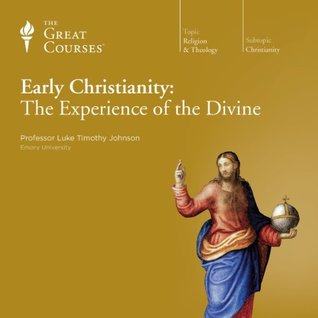
The Great Courses - Early Christianity: The Experience of the Divine - Luke Timothy Johnson, Ph.D. Audiobook
Language: EnglishKeywords:
History
Philosophy
Religion
ttc
Shared by:ihophats
Written by ,
Read by Luke Timothy Johnson, Ph.D.
Format: MP3
Bitrate: 80 Kbps
Unabridged
Length: 12 hrs and 24 mins
Release date: 07-08-13
After 2,000 years, Christianity is the world’s largest religion and continues to prosper and grow. What accounts for its continued popularity? Simply put, Christianity is powerful and persuasive as a religion. It offers a convincing personal experience of ultimate, or “divine,” power.
Hide Full Description
In Early Christianity: The Experience of the Divine, Professor Luke Timothy Johnson maintains that the most familiar aspects of Christianity—its myths, institutions, ideas and morality—are only its outer “husk.” In this two-part course, he takes you on a journey to find the “kernel” of Christianity’s appeal: religious experience. You travel back to Christianity’s origins, its first 300 years, to identify the elements that first made it appealing and which still hold the secret to its ability to attract new followers.
Professor Johnson is a former Benedictine monk and author of 20 books, including The Writings of the New Testament: An Interpretation. At Emory University, he has twice received the “On Eagle’s Wings Excellence in Teaching” Award.
In his presentation, Professor Johnson employs scholarly techniques that have only recently been applied to religion. By combining such disciplines as history, the social sciences, and comparative literary analysis, you look at religious experience and behavior from a fresh perspective.
What is “Religious Experience”?
But if this course is about the nature and power of religious experience, what exactly is that experience?
You consider a variety of theories developed by the philosophers Alfred North Whitehead and Immanuel Kant, Emil Durkheim, the founder of sociology, and Sigmund Freud, before settling on a definition that will be used for the remainder of the course.
To better understand religious experience in Christianity, you then study it in the two religions with which early Christianity co-existed: Greco-Roman paganism and Judaism.
These lectures assume that patterns of behavior can be used to identify religious experience in antiquity. In this sense, all of life in the Roman Empire might be said to be a religious experience. Every human activity—civic, military, domestic, and personal—fell under the power and protection of gods who needed attention for life to be prosperous.
Prophecy and the healing of physical and mental disorders were regarded as revelations of divine power. Participation in mystery cults offered access to deeper realities, as well as social advancement.
In Judaism, religious experience was rooted in the symbolic world of Torah. These scriptures embodied central Jewish convictions such as belief in one God and a sense of themselves as a Chosen People. Torah also defined the ways in which these convictions were to be expressed, through such practices as circumcision and the observance of the Sabbath.
For Jews living in Palestine, religious life focused on the temple, the synagogue, and the family. Palestinian Judaism was also affected by the stress resulting from Greco-Roman oppression. Some Jews splintered into sects. This was accompanied by the appearance of new sources of religious experience:
Apocalyptic writings that offered hopeful visions of God’s future
Intervention of charismatic miracle workers and healers
Prophets such as John the Baptist.
Sources of Religious Experience: Healing, Visions, and Speaking in Tongues
In introducing early Christian religious experience, Professor Johnson looks at questions that are new and intellectually exciting in the study of religion. Was Christ the founder of Christianity? Was Christianity’s early growth due to his life and works or to his followers’ powerful experience of his death and resurrection, their sense of having been transformed by the Holy Spirit?
You see how religious experience in earliest Christianity took on a variety of forms. Fellowship meals celebrated the presence of the resurrected Lord Jesus. Healing was a sign of God’s presence in the world and could certify the healer as a saint. Prayer and visions provided access to, and confirmation of, divine power.
Many practices, however, created problems for early Christian leaders. For example, they rejected demands to add circumcision to baptism as an initiation rite in Christianity. This was due not so much to its use in Judaism as to the fact that it would make Christianity seem similar to pagan religion: a second rite would resemble the multiple initiation rites used by Greco-Roman mystery cults.
Similarly, many Christians saw glossolalia, or speaking in tongues, as a powerful form of religious experience, dating from the experience of the crowd at Pentecost. However, a variety of concerns, including that it could be confused with pagan prophecy or used by women to undermine male authority, quickly led to its marginalization.
Professor Johnson raises important questions. Did institutional development in early Christianity—the creation of its formal structure and creeds—eliminate important sources of religious experience? Or did it minimize certain practices in order to preserve, for millennia, other meaningful avenues of religious experience?
Finding “True” Christianity
There has always been a struggle between “official” Christianity—its institutions and political roles—and “popular” Christianity, which most directly connects Christians to religious experience. In the last lecture, Professor Johnson argues that official Christianity has been accepted as true Christianity due in large part to the way in which its leaders and reformers have defined it and the manner in which academic scholars have studied it.
In the last 15 years or so, new analytical methods have begun to be applied to the study of Christianity. Among these is the approach taken in this course as well as the fresh perspectives offered by women’s history and social history. With these techniques, so-called “popular” Christianity may well come to be understood as real Christianity.

| Announce URL: | |
| This Torrent also has several backup trackers | |
| Tracker: | udp://tracker.open-internet.nl:6969/announce |
| Tracker: | udp://tracker.opentrackr.org:1337/announce |
| Tracker: | udp://tracker.tiny-vps.com:6969/announce |
| Tracker: | udp://tracker.vanitycore.co:6969/announce |
| Tracker: | udp://tracker.torrent.eu.org:451/announce |
| Tracker: | http://tracker.internetwarriors.net:1337/announce |
| Tracker: | http://tracker.vanitycore.co:6969/announce |
| Tracker: | http://retracker.telecom.by/announce |
| Tracker: | udp://tracker.leechers-paradise.org:6969 |
| Tracker: | udp://tracker.coppersurfer.tk:6969 |
| Tracker: | http://retracker.telecom.by:80/announce |
| Creation Date: | Fri, 08 Feb 2019 10:40:45 -0500 |
| This is a Multifile Torrent | |
| 01. Christianity As a Religion.mp3 17.34 MBs | |
| 02. What is a Religion.mp3 17.43 MBs | |
| 03. The Role of Religious Experience.mp3 17.46 MBs | |
| 04. Sourcing Christianity.mp3 17.48 MBs | |
| 05. The Imperial Context.mp3 17.58 MBs | |
| 06. Greco-Roman Polytheism.mp3 17.43 MBs | |
| 07. Greco-Roman Religious Experience.mp3 17.49 MBs | |
| 08. The Symbolic World of Torah.mp3 17.49 MBs | |
| 09. Palestinian Judaism in the Greco-Roman World.mp3 17.48 MBs | |
| 10. Judaism in the Hellenistic Diaspora.mp3 17.49 MBs | |
| 11. Jesus and the Gospels.mp3 17.5 MBs | |
| 12. The Resurrection Experience.mp3 17.93 MBs | |
| 13. Judaism in the Hellenistic Diaspora.mp3 17.44 MBs | |
| 14. Ritual Imprinting and Politics of Perfection.mp3 17.45 MBs | |
| 15. Glossolalia and the Embarrassments of Experience.mp3 17.56 MBs | |
| 16. Meals Are Where the Magic Is.mp3 17.53 MBs | |
| 17. Healing and Salvation.mp3 17.59 MBs | |
| 18. Access to Power—Visions and Prayer.mp3 17.44 MBs | |
| 19. The Holy Community.mp3 17.57 MBs | |
| 20. The Community’s Worship.mp3 17.66 MBs | |
| 21. The Transforming Word of Scripture.mp3 17.69 MBs | |
| 22. Teachers and Creeds.mp3 17.63 MBs | |
| 23. The Power of the Saints.mp3 17.79 MBs | |
| 24. Christianities Popular and Real.mp3 18.16 MBs | |
| 647_00.pdf 1020.29 KBs | |
| Combined File Size: | 422.61 MBs |
| Piece Size: | 256 KBs |
| Comment: | Updated by Education Audiobook |
| Encoding: | UTF-8 |
| Info Hash: | 37cedccf5f69941844166d221c766c93d38e4870 |
| Torrent Download: | Torrent Free Downloads |
| Tips: | Sometimes the torrent health info isn’t accurate, so you can download the file and check it out or try the following downloads. |
| Direct Download: | Start Direct Download |
| Tips: | You could try out alternative bittorrent clients. |
| Secured Download: | Download Files Now |
| AD: |

|





This post has 2 comments with rating of 5/5
February 8th, 2019
Professor Johnson is a superb lecturer/communicator.
February 9th, 2019
Thank you
Add a comment